
In response to the Federal Government’s Budget 2024, announced April 17, 2024.
Analysis from our partners is now available, CFIB (Canadian Federation of Independent Business) and CME (Canadian Manufacturers and Exporters). CFIB Press Release CME Press Release. CKCA is pleased to support both these organizations and their position and response to the budget.
Other reputable sources include, The Conference Board of Canada (Press Release here) and RBC Economics (Press Release here) both publishing their commentary. All of this is helpful for obtaining a summarized version of the more than 400 pages of budget documentation.
So what does it mean for the kitchen cabinet industry?
Background:
- The Canadian kitchen cabinet industry is comprised of more than 4,000 manufacturing shops across Canada making us part of the “economic engine” of Canada and one of many manufacturing sectors that contribute to the GDP.
- In 2023 we generated more than $5 billion in gross revenue sales and employ more than 25,000.
- We supply essential infrastructure (kitchens, bathrooms and other millwork) to the housing industry and are comprised of mostly small to medium sized business (1-500 employees).
- We are an industry in transition that is being impacted by the volatility in the market (interest rates, housing shortages etc.), the skilled labour shortage, an aging demographic of workers and business owners retiring, environmental conditions affecting supply (such as forest fires), advances in automation, complex trade and supply chains and a new generation of workers and business entrepreneurs entering the industry.
- We are a resilient industry that continued to operate through Covid because we were considered an essential industry sector.
- We are considered a “high mix, low volume” industry because we produce a highly customizable product that makes our manufacturing process complex.
- We adhere to Canadian employment standards and safety protocols, environmental standards and we live and work and contribute to communities across Canada.
- Our industry is grass roots and, like so many businesses in Canada, we are comprised of workers and business owners who have brought their woodworking skills to Canada from all over the world.
Our concerns:
- The cost of doing business continues to rise for our sector with increasing taxes, business fees, cost for supplies, labour and more.
- Our industry continues to adopt new technologies and automation that requires significant financial investment. This also comes with increased business risk from cyber attacks and requires retraining/reskilling our employees. It also requires increased dependency and consumption on the power grid (utilities) to run our facilities, all of which is costing more each year.
- Remaining competitive is challenging and we are being impacted by offshore, cheaper product entering Canada at 40-70% cheaper making it impossible to compete, especially on lower end housing. Our industry’s response to this has been to move into the mid to higher end markets to survive.
- Fluctuation and volatility in the market, with inflation impacting interest rates, not only slows the market it increases financial pressures on our businesses who must navigate long lead times and delays before full payment is received, creating risk to both borrowers and lenders.
- The increasing population is growing faster than our ability to build homes which further adds pressure on the housing and rental markets.
- Cycle times on building remain long and since our industry installs some of the more final components in the home, we are frequently faced with costly delays.
- Our sector’s profit ratios remain below the national manufacturing average of just over 9% (we are between 7-8%) which leaves little room for market changes and can create very difficult financial conditions for even the most successful of companies in our industry.
- While many have the perception that our industry did well through Covid, many companies struggled to operate during these challenges times and are still recovering from the unprecedented changes that occured. As one member who has been in business over 40 years told us: “Since Covid, although a few costs have come down, the major contributing costs (our fixed costs) will not come down and if they do, its minimal due to the new cost of doing business. Even though we raised our prices 30-40% during Covid and had a record year in sales due to this increase in 2023, we still had a $2 million shortfall in order to break even.”
Our comments on the budget:
- What Government decides and how it budgets impacts our industry. Our partners have all echoed concerns around the new capital gains taxes and we share their concerns.
- Canada’s GDP has slowed, productivity in Canada has slowed to levels that the Bank of Canada has declared “an emergency” and it is concerning that capital gains taxes on business may de-incentivize further investment in Canadian business.
- We are pleased to see increase funding for SR&ED that supports R&D, our industry is one of many that need more R&D to drive innovations.
- We echo CFIB’s comments that the Employee Ownerships Trusts, that allows business owner to access a special capital gains exemption of up to $10 million when selling a business to their employees, is good as our industry is seeing an increasing number of businesses changing hands and we will continue to see this as our aging workforce retires.
- We are also pleased to finally see some Carbon Tax rebates being returned to small business and commend CFIB for working hard on that issue to represent small business.
- We echo the concerns of the CME who are deeply concerned about the pace of implementation of previously announced measures by Government.
- It is good to see the budget has earmarked $409.6 million over four years, starting in 2025-26, to the Canada Mortgage and Housing Corporation to launch a new Canada Secondary Suite Loan Program, enabling homeowners to access up to $40,000 in low-interest loans to add secondary suites to their homes.
- Increasing affordability for housing, including subsidized housing paid by Government (using taxpayers money) is an important initiative, but creates additional pressure to produce product at the lowest possible price which will likely attract more off-shore cheaper product, even though we can and do manufacture kitchens in Canada. Off-shore product is counterproductive to the Government’s efforts to improve our environmental performance when we know “made in Canada” offers many environmental benefits.
- The budget proposes more support for modular and pre-fab building techniques, this is interesting, but it is too early to know if this will make the significant dent in the housing crisis. A lot will depend on whether the pre-fab industry can scale up quickly enough to respond to high demand and it could further perpetuate cheaper off-shore product entering Canada as a result.
- It is good to see amendments that will help first time buyers afford a home (increasing amortization to 30 years from 25)
- We are pleased to see housing gaining more attention and being prioritized by Government. Our industry wants to be part of the housing solution and to be recognized as a valued stakeholder.
- We look forward to learning more about the Canadian industrial strategy for homebuilding as well as improved data collection from CMHC and StatsCan who will receive $20 million over four years to enhance their data collection and dissemination of housing data, including municipal-level data on housing starts and completions.
- There is no one clear solution to the housing crisis, it is a multi-faceted and complex issue that requires a multi-pronged and innovative approach.
Our message:
While the push to build more homes continues, all levels of government need to ensure they create policy to foster the right conditions that enable Canadian business to effectively supply to an already pressurized housing industry. Our industry’s ability to compete and be successful is at a vulnerable crossroads. With demand for housing never being higher, our industry is not only working through skilled labour shortages and the cost of automation upgrades, it is also changing hands as we see an exodus of people from our sector and businesses being handed down to the next generation. This combined with higher interest rates, carbon tax, increased labour costs, increasing material costs, increasing property and rent costs, higher insurance and more, creates significant risk for many businesses who are looking to Government to provide support as business evolves. The ability to move business from one generation to the next needs to have every opportunity to be successful and viable for those taking over. Federal, provincial and municipal budgets must come with constructive policy and nimble regulations that provide for a positive future and a healthy competitive environment for the next generation of business owners.
Every home has a kitchen. CKCA wants that kitchen to be made in Canada.
 Sivam Coatings S.p.A. is making significant strides in expanding its presence in North America, with a clear focus on solidifying its position on the East Coast while venturing further westward across the USA. As part of this expansion initiative, they are pleased to welcome two distinguished professionals to their North American team.
 Together with North American Sales Director Jakub Stachurski, Jose and Jared collectively contribute over 75 years of extensive experience in the wood coatings industry—a remarkable achievement perfectly aligned with Sivam’s 75th anniversary milestone.


 Planit Canada and Richelieu have joined forces for an innovative hardware package for Cabinet Vision.
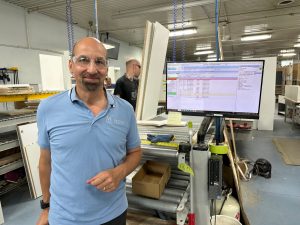 CKCA Board Member Profile: Luke Elias is passionate about technology in manufacturing and in 1989 started implementing computer hardware and software to improve office to shop communications in his Alfred, Ontario company Muskoka Cabinet Company. Early on he invested in cutting and optimization software and invested in a Nested Based Manufacturing in 2000. Today Luke is co-founder of SMARTMRP Inc. an ERP/MES automation software specifically designed for the woodworking industry. With SMART at its core, Muskoka boasts one of the most advanced panel processing cells in the world, utilizing Robotics, RFID, ERP and an AGV, for machining, sorting, labeling, transporting and tracking parts. These innovations have resulted in Muskoka Cabinet having output that is three times the industry average.
  So, since 2016 we have really turned up our data collection process. It has allowed us to not only collect the data, but manipulate and analyze it, and look at ways on how we can increase efficiency and productivity. There are automation projects that we have bought because the data showed us the projects will pay for themselves in less than a year.
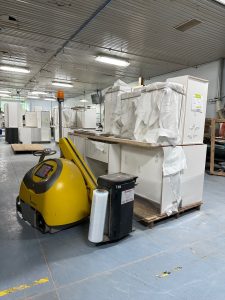 When we first used VSM, we counted 400 steps in the old factory. When we were designing for this new factory we wanted to reduce the number of steps. So, how did we do that? We rearranged and mapped out the movement of the parts. We asked a lot of questions about the positions of the machines and work stations on the shop floor. In thinking through the movement of parts and placement of machinery, we eventually cut the number of steps down to 200. And when we opened the new factory in 2004 we had a really big eye opener. With the same amount of people and the same amount of equipment, our production doubled in the first month. We just couldn’t believe it. Our sales doubled in the first month. With the money we made, we reinvested in further automation. We have been reinvesting and reinvesting ever since.
 People also need to look outside of the wood industry. They need to attend the big automation shows in Canada and the United States. We took our robotics committee to the automation show in Detroit, North America’s largest automation show. At these shows you are going to see a lot of automobile technology. However, technology and automation is transferable. In Detroit, we saw vision systems. A big problem we have in our industry is quality issues – detecting flaws in the product. So, vison technology helps to address our quality issues. We saw a demonstration with a Tesla that had a camera going around the car to detect any faults. It covered every square inch of the car to detect deficiencies of paint, a scratch, or an imperfection, perhaps a weakness in its steel. Now, imagine having this vision system operating on your finishing line! This is a technology that our industry could use now. It would mean big savings. So, we need to go to these shows and learn what is out there that can be used in our facilities today.
 In this photo Luke holds a small RFID tag containing code that allows him to track every single component in his plant. While many will ask how much it costs to produce the tags and attach to everything, Luke will tell you that the more important question the business owner should be asking is how much time and money will this save not trying to track down where components are in the plant. Point well taken Luke!

 If you speak with P. Chacko John at Möbel, he’ll tell you this isn’t just a training program, it’s a “woman empowerment project”. With Möbel’s 30 years in business they recognized that the number of woman in the industry was negligible with marginal growth. They wanted to create opportunities for women to become independent cabinet installation professionals.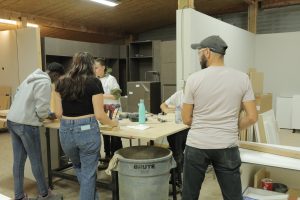

 The Kitchen Cabinet Production Worker Training Program – you need trained workers and we’re creating a supply stream
 The program was created in 2023 in direct response to CKCA members stating there was a need for labour and not just anyone but hires who could hit the ground running. Under the Northwest Industries Association, who has extensive experience as an association running similar employment training, this 9-week government funded training program was designed to prepare unemployed and underemployed persons for work within the Kitchen Cabinet sector. Working closely with CKCA members to understand their needs and skill requirements in potential employees, the Northwest Skills Institute created a hands on training program focused on the use of power and hand tools where students built projects each week, the application of safety, how to create and read blueprints, numeracy skills around imperial to metric conversion, quality control measures, finishing skills using sanders, spray paint guns, stain and varnish, online CNC training, Forklift Theory, Daily Kaizen, OFA 1, WHMIS and much more.
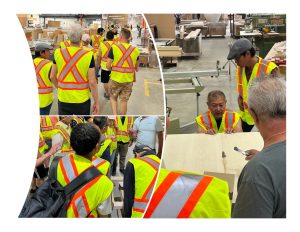 Weekly tours with CKCA members helped students learn about common equipment, the application of Kaizen at work, production procedures, job order tracking software and systems, and opportunities within this sector. Employers in turn had the opportunity to promote their companies and to meet potential hires ahead of time. CKCA would like to sincerely thank those participating companies!
 Cohort 2