Partnership Opportunity with UBC’ Wood Products Co-op Program

Dear CKCA Members,

As the woodworking industry continues to evolve, finding skilled and innovative talent is essential to staying ahead of the curve. We’re excited to announce an exceptional opportunity for CKCA members to partner with the University of British Columbia’s Centre for Advanced Wood Processing | CAWP at UBC Forestry Co-op Program and access a pool of talented students ready to tackle your company’s most pressing challenges.

 Why Choose UBC Co-op Students?

UBC’s Wood Products Co-op Program currently has students available for 4 or 8 month terms starting in May/June.  Students would be ideal for projects such as:

  1. Quality Control: Ensure the highest standards of quality in your products by engaging co-op students to assist in quality control measures and process improvement initiatives.
  2. Development of Standard Operating Procedures (SOPs): Streamline your operations and enhance efficiency by working with students to develop and refine SOPs tailored to your company’s unique needs.
  3. Facility Layout: Optimize your workspace for maximum productivity and safety with the help of co-op students skilled in facility layout design.
  4. Production Planning and Scheduling: Improve your production processes and minimize downtime by enlisting co-op students to assist in production planning and scheduling tasks.
  5. Machinery Evaluation: Evaluate and optimize your machinery and equipment to ensure they meet your company’s production requirements and goals.

Benefits of Partnering with UBC Co-op Program:

  1. Access to Specialized Skills: Leverage the expertise of students trained in Wood Products Processing to address specific challenges and opportunities within your organization.
  2. Flexible Work Terms: Choose between 4-month and 8-month work terms to accommodate your company’s needs and project timelines.
  3. Cost-Effective Solutions: Benefit from cost-effective staffing solutions while gaining access to motivated and talented individuals eager to contribute to your company’s success.  (BC companies may qualify for Wood First Funding)

 Connect with Us:

Ready to take advantage of this exciting opportunity? Reach out to alberto.renteria@ubc.ca  to learn more about how you can partner with UBC’s Co-op Program and harness the potential of our talented students.

Let’s work together to drive innovation, efficiency, and growth within the woodworking industry!

Jason Chiu  B.Sc

Managing Director

UBC – Centre for Advanced Wood Processing

2939 – 2424 Main Mall

Vancouver, BC  Canada  V6T 1Z4

Tel: 604 822-0082

Email: jason.chiu@ubc.ca


Eurocucina 2024 – Trends from two perspectives

CKCA recently sent a group of kitchen cabinet manufacturers to Europe to attend the world’s largest kitchen show – Eurocucina.

This trends setting show is packed full of all the latest in kitchen design and functionality and serves to inspire the transformation of our living spaces.

Blum Canada hosted the group as sponsor and have put an excellent summary together of the trends they saw from the show. We also got the perspective of one of the participants, CKCA member Trevor Chaulk from Chaulk Woodworking. Their two perspectives combined offer valuable insight into what’s trending for the kitchen cabinet industry.

Trevor Chaulk, Chaulk Woodworking

I would like to start off by saying a large thank you to Blum, CKCA, Richelieu and many others who helped make this experience memorable.   The hospitality we have experienced was second to none as usual with CKCA events.

To see many Blum plants in one day and observe how this large company operates, the experience  was really inspiring. From the unified feel across all plants to how they engineer and manufacture all their own machinery(with help from machine companies) and above all their skilled trades apprenticeship programs, it showed me that progress and innovation are not only required but needed for growth and future stability.  The apprenticeship program especially stuck with me as I believe it is imperative for companies to assist with skills training.  The joy and aspiration of their apprentices was uplifting and I would like to see this culture closer to home…It all starts somewhere.

The Eurocucina event was very large.  The amount of effort put forward for a show like this is tremendous!   We toured the Kitchen and Bath Halls, and we identified the importance of creative design and uniqueness of the end consumers of Kitchen and Bath Cabinets (Furniture), fixtures and overall feeling of the space environment.  The innovation is really showcased at this event mainly in new materials being introduced to the marketplace that have vibrant colours, textures and durability.  We noticed the amount of mixed materials in the designs and the element of a modern but grounded feel.  There was a fair amount of new hardware features that we would like to implement back here in Ontario, Canada.  I look forward to attending this show in the future.

Blum Canada

Here’s what Blum had to say about the tour.

Here’s a report Blum has prepared highlighting the trends at Eurocucina.

Thank you to our sponsors for making this a great program!


Budget 2024 – CKCA’s Concerns, Comments and Message

In response to the Federal Government’s Budget 2024, announced April 17, 2024.

Analysis from our partners is now available, CFIB (Canadian Federation of Independent Business) and CME (Canadian Manufacturers and Exporters).  CFIB Press Release  CME Press Release. CKCA is pleased to support both these organizations and their position and response to the budget.

Other reputable sources include, The Conference Board of Canada (Press Release here) and RBC Economics (Press Release here) both publishing their commentary. All of this is helpful for obtaining a summarized version of the more than 400 pages of budget documentation.

So what does it mean for the kitchen cabinet industry?

Background:

  • The Canadian kitchen cabinet industry is comprised of more than 4,000 manufacturing shops across Canada making us part of the “economic engine” of Canada and one of many manufacturing sectors that contribute to the GDP.
  • In 2023 we generated more than $5 billion in gross revenue sales and employ more than 25,000.
  • We supply  essential infrastructure (kitchens, bathrooms and other millwork) to the housing industry and are comprised of mostly small to medium sized business (1-500 employees).
  • We are an industry in transition that is being impacted by the volatility in the market (interest rates, housing shortages etc.), the skilled labour shortage, an aging demographic of workers and business owners retiring, environmental conditions affecting supply (such as forest fires), advances in automation, complex trade and supply chains and a new generation of workers and business entrepreneurs entering the industry.
  • We are a resilient industry that continued to operate through Covid because we were considered an essential industry sector.
  • We are considered a “high mix, low volume” industry because we produce a highly customizable product that makes our manufacturing process complex.
  • We adhere to Canadian employment standards and safety protocols,  environmental standards and we live and work and contribute to communities across Canada.
  • Our industry is grass roots and, like so many businesses in Canada, we are comprised of workers and business owners who have brought their woodworking skills to Canada from all over the world.

Our concerns:

  • The cost of doing business continues to rise for our sector with increasing taxes, business fees, cost for supplies, labour and more.
  • Our industry continues to adopt new technologies and automation that requires significant  financial investment. This also comes with increased business risk from cyber attacks and requires retraining/reskilling our employees. It also requires increased  dependency and consumption on the power grid (utilities) to run our facilities, all of which is costing more each year.
  • Remaining competitive is challenging and we are being impacted by offshore, cheaper product entering Canada at 40-70% cheaper making it impossible to compete, especially on lower end housing. Our industry’s response to this has been to move into the mid to higher end markets to survive.
  • Fluctuation and volatility in the market, with inflation impacting interest rates, not only slows the market it increases financial pressures on our businesses who must navigate long lead times and delays before full payment is received, creating risk to both borrowers and lenders.
  • The increasing population is growing faster than our ability to build homes which further adds pressure on the housing and rental markets.
  • Cycle times on building remain long and since our industry installs some of the more final components in the home, we are frequently faced with costly delays.
  •  Our sector’s profit ratios remain below the national manufacturing average of just over 9% (we are between 7-8%) which leaves little room for market changes and can create very difficult financial conditions for even the most successful of companies in our industry.
  • While many have the perception that our industry did well through Covid, many companies struggled to operate during these challenges times and are still recovering from the unprecedented changes that occured. As one member who has been in business over 40 years told us: “Since Covid, although a few costs have come down, the major contributing costs (our fixed costs) will not come down and if they do, its minimal due to the new cost of doing business. Even though we raised our prices 30-40% during Covid and had a record year in sales due to this increase in 2023, we still had a $2 million shortfall in order to break even.”

Our comments on the budget:

  • What Government decides and how it budgets impacts our industry. Our partners have all echoed concerns around the new capital gains taxes and we share their concerns.
  • Canada’s GDP has slowed, productivity in Canada has slowed to levels that the Bank of Canada has declared “an emergency” and it is concerning that capital gains taxes on business may de-incentivize further investment in Canadian business.
  • We are pleased to see increase funding for SR&ED that supports R&D, our industry is one of many that need more R&D to drive innovations.
  • We echo CFIB’s comments that the Employee Ownerships Trusts, that allows business owner to access a special capital gains exemption of up to $10 million when selling a business to their employees, is good as our industry is seeing an increasing number of businesses changing hands and we will continue to see this as our aging workforce retires.
  • We are also pleased to finally see some Carbon Tax rebates being returned to small business and commend CFIB for working hard on that issue to represent small business.
  • We echo the concerns of the CME who are deeply concerned about the pace of implementation of previously announced measures by Government.
  • It is good to see the budget has earmarked $409.6 million over four years, starting in 2025-26, to the Canada Mortgage and Housing Corporation to launch a new Canada Secondary Suite Loan Program, enabling homeowners to access up to $40,000 in low-interest loans to add secondary suites to their homes.
  • Increasing affordability for housing, including subsidized housing paid by Government (using taxpayers money) is an important initiative, but creates additional pressure to produce product at the lowest possible price which will likely attract more off-shore cheaper product, even though we can and do manufacture kitchens in Canada. Off-shore product is counterproductive to the Government’s efforts to improve our environmental performance when we know “made in Canada” offers many environmental benefits.
  • The budget proposes more support for modular and pre-fab building techniques, this is interesting, but it is too early to know if this will make the significant dent in the housing crisis. A lot will depend on whether the pre-fab industry can scale up quickly enough to respond to high demand and it could further perpetuate cheaper off-shore product entering Canada as a result.
  • It is good to see amendments that will help first time buyers afford a home (increasing amortization to 30 years from 25)
  • We are pleased to see housing gaining more attention and being prioritized by Government. Our industry wants to be part of the housing solution and to be recognized as a valued stakeholder.
  • We look forward to learning more about the Canadian industrial strategy for homebuilding as well as improved data collection from CMHC and StatsCan who will receive $20 million over four years to enhance their data collection and dissemination of housing data, including municipal-level data on housing starts and completions.
  • There is no one clear solution to the housing crisis, it is a multi-faceted and complex issue that requires a multi-pronged and innovative approach.

Our message:

While the push to build more homes continues, all levels of government need to ensure they create policy to foster the right conditions that enable Canadian business to effectively supply to an already pressurized housing industry. Our industry’s ability to compete and be successful is at a vulnerable crossroads. With demand for housing never being higher, our industry is not only working through skilled labour shortages and the cost of automation upgrades, it is also changing hands as we see an exodus of people from our sector and businesses being handed down to the next generation. This combined with higher interest rates, carbon tax, increased labour costs, increasing material costs, increasing property and rent costs, higher insurance and more, creates significant risk  for many businesses who are looking to Government to provide support as business evolves. The ability to move business from one generation to the next needs to have every opportunity to be successful and viable for those taking over. Federal, provincial and municipal budgets must come with constructive policy and nimble regulations that provide for a positive future and a healthy competitive environment for the next generation of business owners.

Every home has a kitchen. CKCA wants that kitchen to be made in Canada.


CANFER Regulations – Registration deadline was March 8

CKCA and other organizations joined CANFER The Right Reg to represent our industry and speak up about our concerns with regard to the Formaldehyde Emissions from Composite Wood Products Regulations (CANFER). Industry should be aware that the deadline for registering was March 8, 2024.

Two articles were published on this topic that further explain the issues:

CKCA would like to thank our members who have spoken up to support the revisions to these regulations. We are also very grateful to the International Wood Products Association and Elizabeth Baldwin, Environmental Compliance Officer for Metropolitan Hardwood Floors for their tireless efforts to represent the interests of the secondary wood manufacturing sector.

How to register and link are available here »

While we are seeking revisions to these regulations and CKCA is part of CANFER The Right Reg, these regulations are law and you should be registered.  CANFER The Right Reg has submitted two sets of comments to Health Canada that focus on key points on the record-keeping burnden and stakeholder responsibilities,  as well as comments requesting technical fixes to better harmonize with TSCA Title VI. To view what has been submitted please visit COMMENTS | The Right Regulation

In addition, you should be labelling. Here is some information around the requirements to label:

    1. Dual English Dual English and French labeling text is required (English/French translations of required compliance statement text is included in CANFER regulation: https://www.canada.ca/en/health-canada/services/chemical-substances/chemicals-management-plan/initiatives/guidance-document-formaldehyde-emissions-composite-wood-products-regulations.html)
    2. Labeling format requirements:  statement must have color contrast (not blend in/not be hidden), ≥2mm type height, be distinguishable from other graphic material on package

Once we receive an update on  these regulations, CKCA will set up training time so that our industry can follow and ensure compliance with the regulations. For now, this is the only information we have available to us.

In the meantime, if you wish to participate in CANFER The Right Reg to help keep the pressure up to get the revisions we need please see below:

Write to your Members of Parliament and to the Minister of Health urging them to respond positively to the offered comments.  Templates for letters can be found at www.therightreg.ca/letters.  Support for their outreach can be provided at www.therightreg.ca/supportl.

CKCA Local MeetUp – BC – Fall date TBA

CKCA Local MeetUp – BC

Dates TBC for another meetup in Fall 2024. Hope to see you there!

If you want to champion a meetup in your area, get in touch with us. We’ll match you up with a sponsor and get one on the calendar. It’s a great way to connect with industry in your area and it’s free!

If you attended our local meetup on April 25, 2024 at Troico, thank you for attending, it was great to see you there.

We’d also like to thank our local champion Troico for hosting.

Special thanks to our MeetUp sponsor:

What made these companies successful?

CKCA is proud of all its members. Canada has an excellent reputation worldwide for it’s woodworking skills and our history goes back a long way. But in this modern era, how do companies remain competitive while still offering a highly customizable product? Each company has carved out (no pun intended!) their own path and their stories,  their passion and commitment will have you wanting to work with them – and we want that too. We want consumers to buy Canadian-build kitchen cabinetry and there are so many excellent reasons to work with CKCA members.

In 2023 we collected a number of stories to share and inspire.What are the ingredients for success? Be sure to check out what these members say here.

CKCA’s First Local MeetUp a Success!

CONNECT WITH COLLEAGUES

CKCA Local MeetUp a Success! 

CKCA hosted the first local MeetUp for industry this week in Burnaby, BC at Upper Canada Forest Products offices who kindly agreed to be our first host!

With more than 40 in attendance, UCFP provided updates and a tour for manufacturers followed by an open session that invited local suppliers. We also had CKCA Board Members James Dewinetz (Pacific Rim Cabinets) and Gerald Van Woudenberg (Van Arbour Design) speak to the group about the benefits of CKCA membership.

The event is just the beginning of new local events CKCA wants to host across the country. Getting together for a few hours eve

ry few months is doable for many manufacturers. CKCA will continue to host our valuable monthly Manufacturers Roundtable as well as two national events coming up in May and October in 2024. Watch for details on those events coming soon.

Looking to connect locally with other companies? CKCA wants to host more local MeetUps for members an

d non-members. If you’d like to host a MeetUp in your area, get in touch with us. We need local champions to get these off the ground. Face-to-face connections are still #1 for building business relationships and learning from each other.

Contact: sandra@ckca.ca

CKCA Launches “HR Suite of Tools” for members

We’ve been listening to what our members need and HR is often listed at the top priority.

Managing HR is the cornerstone to success of any business. Some businesses have an HR Manager on staff, some outsource and others manage it themselves.  But HR is a risk area for any company and we want to link our members to the best resources to help them. In a market where labour shortages are common, we are working to arm our members with a suite of HR tools. Everything from promotion to recruitment to advice. CKCA is here to help our industry succeed.

We’re pleased to announce our new partnership with HR Covered. The largest Canadian-owned HR company in Canada. Because we know it’s important to get the right advice from the right source.

In addition, a reminder to CKCA members that you may also access the HR tools available through our partnership with CFIB (Canadian Federation of Independent Business).

What does the HR suite of tools include?

  • Unlimited access to the document library – over 700 HR templates and policies designed by HR experts (available in English and French)
  • Free 30 minute HR Health Check
  • Receive HR Covered’s National newsletter covering key trends and policy changes.
  • Access free webinars on various topics including consulting HR lawyers, discussions on hiring foreign workers, recruitment strategies and more (these are excellent webinars!).
  • 50% off recruiting commission
  • Plus, if you’re looking for addition HR support, you can access different programs including Unlimited HR Advice, Unlimited Legislative Training and Unlimited Employment Law and these services come with a 30-day money back guarantee.
  • Access free templates and documents through your membership with CFIB (included with your CKCA membership)
  • Get 40% off Payworks payroll services
  • Access more than 50 free on-line courses on business management and compliance through Vubiz
  • 10% discount on training programs for your staff offered through Centre for Advanced Wood Processing and Wood Manufacturing Council
  • Access to graduates from the entry level training (pilot program) for kitchen cabinet production worker (now only available in BC, but will be expanding)
  • Medical benefits through CKCA’s program with Desjardins Insurance plus free employee discount program of 10%-60% on thousands of brands when you purchase CKCA benefits (more employee perks that cost you nothing!)
  • 25% discount at Goodlife Fitness for all your staff
  • 10% discount cards at Mark’s Work Warehouse for all your staff
  • Access to CKCA recruitment tools, videos plus a 15% discount on recruitment videos through CKCA’s provider
  • Free job listings with woodworkingjobs.ca
  • CKCA scans for industry data, employment updates and strategic intel to help you manage HR in your business
  • Last, but not least – you are not alone. We’re looking to host regular HR roundtable discussions via Zoom. If you’re interested in participating, get in touch with us below.

And there’s more coming with additional videos that interview different career opportunities in the industry, along with information sheets and wage level information.

CKCA members can access all these tools. We’re here to help.

For more information on how to access all these services and discounts please contact info@ckca.ca or call us at 613-493-5858

It’s all about data – An interview with Luke Elias of Muskoka Cabinet Company

CKCA Board Member Profile: Luke Elias is passionate about technology in manufacturing and in 1989 started implementing computer hardware and software to improve office to shop communications in his Alfred, Ontario company Muskoka Cabinet Company. Early on he invested in cutting and optimization software and invested in a Nested Based Manufacturing in 2000.  Today Luke is co-founder of SMARTMRP Inc. an ERP/MES automation software specifically designed for the woodworking industry. With SMART at its core, Muskoka boasts one of the most advanced panel processing cells in the world, utilizing Robotics, RFID, ERP and an AGV, for machining, sorting, labeling, transporting and tracking parts. These innovations have resulted in Muskoka Cabinet having output that is three times the industry average.

 CKCA Board member Luke Elias, president of Muskoka Cabinet Company, joins us to discuss technology and automation in the kitchen cabinet industry.


CKCA: Luke, can you share the most significant thing you have done in the last 5 years to advance your business interests?

Data collection. We started seriously collecting data about 2016 when we put in the first robotic cell. This gave us an opportunity to apply our RFID (radio frequency identification) labels to parts in an automatic fashion. Prior to that, we had been using RFID but only at the product level. So, every kitchen cabinet would have one RFID label on the back of it. The reason why we didn’t RFID and track every single part is because it is too labour intensive, but when we brought in the robotics cell we saw multiple ways to use it. We decided to put RFID labels on every part and, using the cell, we automated the application of this.

So, since 2016 we have really turned up our data collection process. It has allowed us to not only collect the data, but manipulate and analyze it, and look at ways on how we can increase efficiency and productivity. There are automation projects that we have bought because the data showed us the projects will pay for themselves in less than a year.

I also want to credit my phenomenal team. Everyone is enthusiastic about what we are doing here.

CKCA: The automation and robotics on the floor at Muskoka Cabinet is a giant leap when compared to the floors of some of your peers. How does a business owner take the first steps and begin to approach automation of their shop?

When we were designing this factory back in 2003 we used value stream mapping (VSM). That is one of the most valuable tools that anyone can get. It is not easy, but it is laborious. It is not expensive, but it requires a lot of hard disciplined work. You are actually mapping out the process, from when the board arrives at the shop, and the whole process it goes through until it is an assembled kitchen cabinet and is packaged and shipped out the door. We used white boards and had meetings with the employees. You have to prompt the employees because they miss steps when it is an action that is second nature to them.
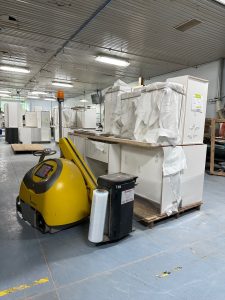
When we first used VSM, we counted 400 steps in the old factory. When we were designing for this new factory we wanted to reduce the number of steps. So, how did we do that? We rearranged and mapped out the movement of the parts. We asked a lot of questions about the positions of the machines and work stations on the shop floor. In thinking through the movement of parts and placement of machinery, we eventually cut the number of steps down to 200. And when we opened the new factory in 2004 we had a really big eye opener. With the same amount of people and the same amount of equipment, our production doubled in the first month. We just couldn’t believe it. Our sales doubled in the first month. With the money we made, we reinvested in further automation. We have been reinvesting and reinvesting ever since.

CKCA: Are there places business owners and managers can look to learn and understand how to introduce and establish automation in their shop? Where can someone turn to get ideas and examples for introducing automation?

One place is to take part in CKCA’s conferences, tours and meetings. Through the CKCA we can visit other shops. This is a great opportunity. I always come away from the events and tours with something I’ve learned.

You also have to attend trade shows. You may not see amazing things in every booth but you are going to find golden nuggets at a trade show — maybe in some little 10 x 10 booth in the back where this small company is offering some technology that you wouldn’t have read about because they don’t have the money to promote themselves. It’s a little nugget that will pay off.

People also need to look outside of the wood industry. They need to attend the big automation shows in Canada and the United States. We took our robotics committee to the automation show in Detroit, North America’s largest automation show. At these shows you are going to see a lot of automobile technology. However, technology and automation is transferable. In Detroit, we saw vision systems.  A big problem we have in our industry is quality issues – detecting flaws in the product. So, vison technology helps to address our quality issues. We saw a demonstration with a Tesla that had a camera going around the car to detect any faults. It covered every square inch of the car to detect deficiencies of paint, a scratch, or an imperfection, perhaps a weakness in its steel. Now, imagine having this vision system operating on your finishing line! This is a technology that our industry could use now. It would mean big savings. So, we need to go to these shows and learn what is out there that can be used in our facilities today.

CKCA: Is there something that you specifically wish to convey about automation with CKCA’s membership?

One has to wonder what is stopping people from diving in? Money? It shouldn’t be money. The money is really secondary. We need to study the processes and the data and not be so focused on the money. The first question I always get asked when someone is touring my business is, “How much is a FRID tag?” Well, it’s 8 to 13 cents. Then you see them calculating the number of parts in a cabinet and they think “OMG, what is that going to cost?!” People are focused on the cents and not thinking how much this would save them with the process… When you see your business bottom line, everything becomes apparent. Seriously, it’s all about the data.

In this photo Luke holds a small RFID tag containing code that allows him to track every single component in his plant. While many will ask how much it costs to produce the tags and attach to everything, Luke will tell you that the more important question the business owner should be asking is how much time and money will this save not trying to track down where components are in the plant. Point well taken Luke!

 

Women Installers Training Program gets started

October 2023

Back in 2018 CKCA conducted an industry study based on input from members that there was a growing shortage of kitchen cabinet installers. While this career path can be quite lucrative, manufacturers are increasingly challenged to find installers. As this part of the kitchen cabinet manufacturing process is absolutely stage of deliver, the role of the installer is higher valued and sought after.

CKCA member, Möbel Cabinetry based in Hamilton, Ontario  decided it was time to do something about it. They approached the Wood Manufacturing Council to help fund a new training program. They wanted to create and encourage women to consider a career as a kitchen cabinet installer. And so began a great partnership that is currently underway.

If you speak with P. Chacko John at Möbel, he’ll tell you this isn’t just a training program, it’s a “woman empowerment project”. With Möbel’s 30 years in business they recognized that the number of woman in the industry was negligible with marginal growth. They wanted to create opportunities for women to become independent cabinet installation professionals.

With a whopping 80,000 construction workers set to retire in the next decade in Ontario, this being widely published,  there needs to be some serious steps to fill those gaps. Because at the same time this shortage is growing, the need for more housing grows too. Ontario alone is looking to build some 1.5 million homes over the next 10 years. With over 500,000 currently in the construction industry in Ontario, just crunch these numbers and the massive bottleneck gets bigger. Companies are already feeling the pinch significantly with more than half (55%) of Canadian entrepreneurs are struggling to hire workers (according the the Business Development Bank of Canada, Fall 2021 study).

The labour shortage is a massive issue and it is a systemic issue. There is no cookie-cutter solution. However, programs such as the WIIT (Women in Installation Trade) program as well as CKCA’s Kitchen Cabinet Production Worker Training Program are programs that are working to address the problem. While they may be small compared to the problem, we all know that solutions have to start somewhere. “The more people we can get interested in our industry, the better and the more people who understand the opportunities that reside in our industry is even better still” says Sandra Wood, CKCA Executive Director.

Recently Möbel’ Cabinetry was featured on the local news. Be sure to check out the news video clip here »

On behalf of the CKCA we’d like to commend Möbel’ Cabinetry and the Wood Manufacturing Council (WMC) for supporting this program. We wish them continued success and we encourage women to take a second look at career paths that they might not typically consider was suitable. You could be pleasantly surprised!