
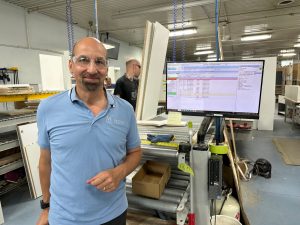
 CKCA Board Member Profile: Luke Elias is passionate about technology in manufacturing and in 1989 started implementing computer hardware and software to improve office to shop communications in his Alfred, Ontario company Muskoka Cabinet Company. Early on he invested in cutting and optimization software and invested in a Nested Based Manufacturing in 2000. Today Luke is co-founder of SMARTMRP Inc. an ERP/MES automation software specifically designed for the woodworking industry. With SMART at its core, Muskoka boasts one of the most advanced panel processing cells in the world, utilizing Robotics, RFID, ERP and an AGV, for machining, sorting, labeling, transporting and tracking parts. These innovations have resulted in Muskoka Cabinet having output that is three times the industry average.
CKCA Board member Luke Elias, president of Muskoka Cabinet Company, joins us to discuss technology and automation in the kitchen cabinet industry.
CKCA: Luke, can you share the most significant thing you have done in the last 5 years to advance your business interests?
Data collection. We started seriously collecting data about 2016 when we put in the first robotic cell. This gave us an opportunity to apply our RFID (radio frequency identification) labels to parts in an automatic fashion. Prior to that, we had been using RFID but only at the product level. So, every kitchen cabinet would have one RFID label on the back of it. The reason why we didn’t RFID and track every single part is because it is too labour intensive, but when we brought in the robotics cell we saw multiple ways to use it. We decided to put RFID labels on every part and, using the cell, we automated the application of this.
 So, since 2016 we have really turned up our data collection process. It has allowed us to not only collect the data, but manipulate and analyze it, and look at ways on how we can increase efficiency and productivity. There are automation projects that we have bought because the data showed us the projects will pay for themselves in less than a year.
I also want to credit my phenomenal team. Everyone is enthusiastic about what we are doing here.
CKCA: The automation and robotics on the floor at Muskoka Cabinet is a giant leap when compared to the floors of some of your peers. How does a business owner take the first steps and begin to approach automation of their shop?
When we were designing this factory back in 2003 we used value stream mapping (VSM). That is one of the most valuable tools that anyone can get. It is not easy, but it is laborious. It is not expensive, but it requires a lot of hard disciplined work. You are actually mapping out the process, from when the board arrives at the shop, and the whole process it goes through until it is an assembled kitchen cabinet and is packaged and shipped out the door. We used white boards and had meetings with the employees. You have to prompt the employees because they miss steps when it is an action that is second nature to them.
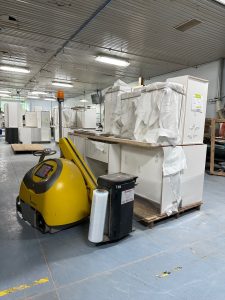 When we first used VSM, we counted 400 steps in the old factory. When we were designing for this new factory we wanted to reduce the number of steps. So, how did we do that? We rearranged and mapped out the movement of the parts. We asked a lot of questions about the positions of the machines and work stations on the shop floor. In thinking through the movement of parts and placement of machinery, we eventually cut the number of steps down to 200. And when we opened the new factory in 2004 we had a really big eye opener. With the same amount of people and the same amount of equipment, our production doubled in the first month. We just couldn’t believe it. Our sales doubled in the first month. With the money we made, we reinvested in further automation. We have been reinvesting and reinvesting ever since.
CKCA: Are there places business owners and managers can look to learn and understand how to introduce and establish automation in their shop? Where can someone turn to get ideas and examples for introducing automation?
One place is to take part in CKCA’s conferences, tours and meetings. Through the CKCA we can visit other shops. This is a great opportunity. I always come away from the events and tours with something I’ve learned.
You also have to attend trade shows. You may not see amazing things in every booth but you are going to find golden nuggets at a trade show — maybe in some little 10 x 10 booth in the back where this small company is offering some technology that you wouldn’t have read about because they don’t have the money to promote themselves. It’s a little nugget that will pay off.
 People also need to look outside of the wood industry. They need to attend the big automation shows in Canada and the United States. We took our robotics committee to the automation show in Detroit, North America’s largest automation show. At these shows you are going to see a lot of automobile technology. However, technology and automation is transferable. In Detroit, we saw vision systems. A big problem we have in our industry is quality issues – detecting flaws in the product. So, vison technology helps to address our quality issues. We saw a demonstration with a Tesla that had a camera going around the car to detect any faults. It covered every square inch of the car to detect deficiencies of paint, a scratch, or an imperfection, perhaps a weakness in its steel. Now, imagine having this vision system operating on your finishing line! This is a technology that our industry could use now. It would mean big savings. So, we need to go to these shows and learn what is out there that can be used in our facilities today.
CKCA: Is there something that you specifically wish to convey about automation with CKCA’s membership?
One has to wonder what is stopping people from diving in? Money? It shouldn’t be money. The money is really secondary. We need to study the processes and the data and not be so focused on the money. The first question I always get asked when someone is touring my business is, “How much is a FRID tag?” Well, it’s 8 to 13 cents. Then you see them calculating the number of parts in a cabinet and they think “OMG, what is that going to cost?!” People are focused on the cents and not thinking how much this would save them with the process… When you see your business bottom line, everything becomes apparent. Seriously, it’s all about the data.
 In this photo Luke holds a small RFID tag containing code that allows him to track every single component in his plant. While many will ask how much it costs to produce the tags and attach to everything, Luke will tell you that the more important question the business owner should be asking is how much time and money will this save not trying to track down where components are in the plant. Point well taken Luke!


 Luke Elias, Muskoka Cabinet Company
 Candybox Marketing does and that’s why CKCA has partnered with Candybox to help our members get sound advice from the experts. Recently ranked No. 188 on the 2018